October is the month of masks. We’ve got superheroes, villains, lucha libre wrestlers, masquerade balls (if you do that sort of thing), and of course, Halloween. We pretend masks are just costumes, but our brains know better. Masks flip switches in us. They change how we act, how we perceive others, and how others perceive us. They’re psychological engines disguised as accessories.
Humans have put things on their faces for thousands of years for many reasons: to protect, to perform, for ritual, or to become someone slightly more interesting than their default settings. A mask is never just a mask. At the primal level, it’s an identity switch, a cultural artifact, a piece of engineered material that changes how you move through the world. The moment you cover your face, even partially, you shift. Your confidence, behavior, and how others read you change. That’s why masks are an illuminating lens for talking about psychology, culture, and the weird science of what we choose to hide.
If you train BJJ, you already know the cultural overlap with lucha libre, the Mexican wrestling tradition where masks are sacred. A luchador’s mask isn’t just a fabric or leather shield; it’s identity, lineage, honor, persona, and myth all stitched together. Losing your mask in lucha libre is a career-altering event, almost like losing your name. Most grapplers have felt the masked identity effect at least once: rolling with someone in a surgical mask, training with a partner who sports a Halloween mask, spotting a luchador mask at open mat, or even wearing a mouthguard that makes you look like a shark. Masked fighters feel more intimidating to you because your amygdala is firing, your prefrontal cortex is guessing, and your brain is whispering, “I don’t know who you are, but I’m paying attention.” Masks change the energy in the room. They make the familiar feel unfamiliar, and that’s thrilling.

Masks aren’t just cultural symbols. Masks are biological and psychological environments. When you put one on, you create a microclimate: warm air, moisture, microbes, and the engineered materials that try (and sometimes fail) to manage it. Not to gross you out, but if you’ve ever worn a silicone mask or one of those flimsy plastic party masks, you know exactly what I mean. The materials matter: woven fibers, polymers, foams, and composites all change airflow, temperature, and how your skin microbiome behaves. A mask is a lab experiment on your face, and your body reacts to it in real time. Your brain responds too. Vision narrows, social cues drop, and your amygdala and prefrontal cortex renegotiate how much threat, confidence, or anonymity you feel.
Your Brain on Masks
When you see a covered face, your brain works harder. We talked about the amygdala back in the “It’s Never Too Late” blog. It’s the little almondshaped threat detector that loves to overreact when information is missing. Masks are basically a missinginformation machine. fMRI (functional magnetic resonance imaging) lets researchers watch bloodflow changes in active brain regions. When the face disappears, the brain shifts into a different mode; one part ancient, one part analytical. The amygdala reacts to the unknown, leaning on quickanddirty pattern-based guesses; the prefrontal cortex tries to translate it by regulating the emotional response and keeping you from jumping at shadows. Missing information triggers a primitive “better safe than sorry” circuitry.

Behavioral Outcomes: How Masks Tilt Social Interaction
Once you understand what the brain is doing, the behavior that follows makes perfect sense. When you’re looking at a masked face, your amygdala is already running its “missing data” protocol, and your prefrontal cortex is trying to keep the peace. That internal tugofwar shows up in how you interact with people.
Ambiguity makes us cautious. With half the face hidden, you lose mouth shape, cheek tension, and microexpressions, which are all the tiny cues that tell you whether someone is friendly, annoyed, joking, or about to ask if they can practice their rear naked choke on you. Your brain leans conservative: slower to trust, slower to interpret, slower to relax.
Anonymity makes them (the mask wearer) bolder; it lowers inhibition. Flip the perspective and the maskwearer gets a tiny psychological shield. It’s the phenomenon we see every Halloween: cover part of the face, and people loosen up. They talk more freely, act more confidently, and sometimes get a little weird. When you’re partially hidden, you feel less observed, and humans behave differently when they feel less observed.
Misreads multiply. Because your brain is filling in blanks, you’re more likely to misinterpret tone or intent. A neutral masked face can read as cold. A happy masked face can read as neutral. A slightly tense masked face can read as “this person mad at me.” The amygdala doesn’t default to fear, but it does default to caution, and caution colors perception.
Social friction increases in tiny ways; not dramatic ways, subtle ways when interacting with a mask wearer. Conversations take a beat longer. Greetings feel slightly formal, and you may feel more self-conscious. You rely more on voice tone and less on facial nuance. In gyms, on mats, in crowds, masks shift the vibe just enough that you notice it without always knowing why.
Put all of this together, and you get a simple truth: Masks don’t just change how we look. They change how we behave and how we interpret the behavior of others. Masks have never been just a covering. They’ve always been tools for identity, status, mischief, and meaning.
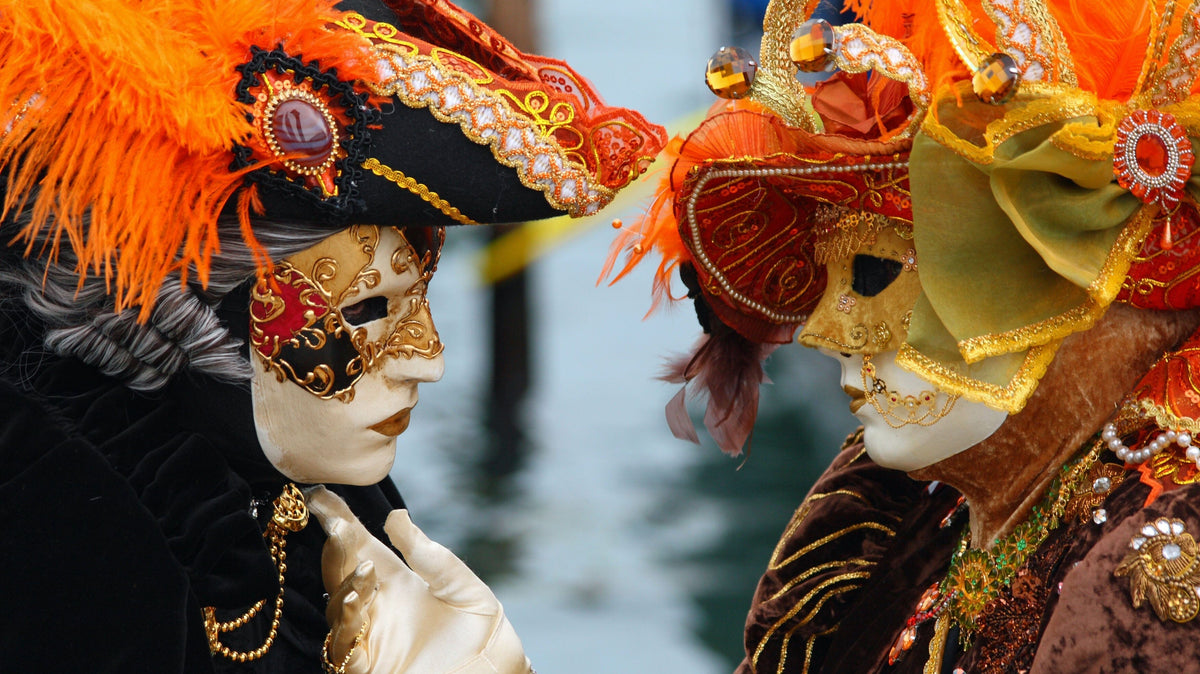
Masks have been made from just about everything humans could shape with their hands: bone, leather, metal, clay, wood, feathers, fabric, resin, latex, paper, even woven plant fibers. Each material changes how expressive the mask is, how comfortable it feels, how “alive” it looks when worn, and how intimidating it appears. A carved wooden mask feels ancient and ceremonial; a metal war mask looks fierce and unyielding; a feathered Mardi Gras mask feels playful and extravagant. More than decoration, the material determines the personality of the mask itself. A mask is part costume, part psychology, part engineering.

Across cultures, masks give people social permission to act differently. Carnival masks let you flirt, joke, and misbehave without the usual consequences. Ritual masks let you step out of your everyday self and into the role of ancestor, spirit, animal, or hero. Even modern surgical masks create a psychological buffer that makes people feel less observed and freer to be weird, or, for an actual surgeon, focused on the task at hand.
Warriors, shamans, dancers, and performers have used masks to project authority or otherworldliness. A mask can make you look larger, more intimidating, or more divine. It’s a way of saying, “I’m not me right now. I’m someone or something else.” That “something else” varies by culture, but can be a shift in the social hierarchy.
Some masks protect the body (plague doctors, welders, fencers). Others protect the psyche (theatrical masks that let actors express emotions too big for a bare face). Some protect the community. Think of ceremonial masks meant to guard against misfortune or invite good spirits. Protection isn’t always about germs. Sometimes it’s about meaning.
From Japanese Noh theater to Mexican lucha libre to Venetian masquerades, masks let people experiment with identity and transformation. They soften the boundary between “me” and “the role I’m playing.” When you cover the face, you loosen the rules. You can be braver, stranger, funnier, or more dramatic than you’d ever allow yourself to be unmasked.
Masks let us hide, reveal, transform, and play, disrupting identity in a way the brain finds irresistible. Masks make the familiar feel unfamiliar and permit us to step outside ourselves, whether we’re celebrating Halloween, rolling with a masked grappler, or watching a luchador become a legend. October is the season when masks take center stage, but our fascination with them is timeless. They remind us that identity is flexible, perception is powerful, and sometimes the simple act of covering the face can unlock a version of ourselves we don’t always get to show. That’s why we love them (or dislike them). Because for a moment, behind a mask, we get to be someone else, and our brains absolutely light up at the chance.